 English
 Türkçe
  العربية
  Русский
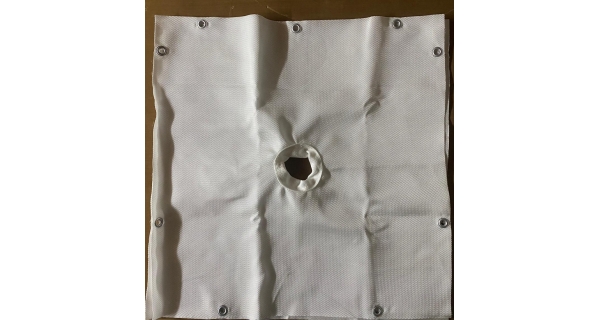
The right filter press cloth is selected by matching the filter medium to the slurry, process conditions and filtration objective rather than by choosing a plate size or micron rating alone. Particle-size distribution, solids concentration, chemistry, temperature, required filtrate clarity, flow rate, cake release, cleanability and physical fit to the filter plate all influence the decision.
There is therefore no universal filter cloth that is best for every filter press. A fabric that is too open may allow excessive fine solids to pass, especially during early cake formation. A fabric that is too restrictive can reduce flow, extend cycle time and become blinded more quickly. Good selection is a balance between solids retention, throughput, cake behavior and practical operation.
Start by Defining the Filtration Objective
Before comparing fabrics, define what the process needs the cloth to achieve. In one application, clear filtrate may be the primary requirement. In another, shorter filtration cycles, easier cake discharge or resistance to repeated cleaning may matter more.
These objectives can involve trade-offs. A tighter fabric may improve initial solids retention but can also restrict liquid flow. A more open fabric may support higher throughput while permitting more fine particles to pass before a stable cake develops. The correct choice is not the fabric with the lowest or highest single specification; it is the fabric whose overall behavior suits the process target.
Evaluate Particle-Size Distribution and Solids Characteristics
Average particle size alone does not fully describe how a slurry will behave on a filter cloth. The distribution of fine and coarse particles, particle shape and whether the solids are sticky, fibrous, crystalline or highly compressible can all affect cake formation and cloth blinding.
Solids concentration is also important. At the beginning of a filtration cycle the cloth acts as the supporting separation surface, but as solids accumulate the developing filter cake becomes a major part of the filtration mechanism. This is why selecting a cloth only by asking for the smallest particle size in microns can be misleading. The way the particles build a cake and interact with the fabric must also be considered.
Do Not Select a Cloth by Micron Rating Alone
Woven filter media do not behave like a simple screen with one perfectly uniform opening size. Actual retention is affected by pore distribution, yarn construction, weave pattern, thickness, surface finish and the cake that develops during operation.
Two cloths with a similar nominal micron value can therefore produce different filtrate clarity, flow rates and blinding behavior on the same slurry. Micron information can be useful as part of the specification, but it should be evaluated together with permeability and fabric construction.
Match Permeability to the Required Balance of Flow and Retention
Permeability indicates how readily fluid can move through the fabric under defined test conditions. Higher permeability is not automatically better. If the fabric is too permeable for the slurry, solids retention may be inadequate. If permeability is too low, the cloth can unnecessarily restrict flow and increase filtration time.
It is also important to distinguish laboratory permeability from long-term operating behavior. Fine particles, oily components, sticky solids and cleaning history can alter effective permeability as the cloth is used. For this reason, a cloth should be evaluated not only for initial flow but also for its tendency to blind and its ability to recover after cleaning.
Consider Yarn Type and Weave Construction
Yarn and weave construction influence surface smoothness, particle retention, cake release, cleanability and mechanical stability. Monofilament fabrics often provide a smoother surface and can be easier to clean and release cake from, while multifilament structures can offer stronger fine-particle retention in suitable applications. Combination constructions can be used when a balance of these properties is required.
The polymer name alone is therefore not enough to define a filter cloth. Two fabrics made from the same polymer can perform differently because their yarn diameter, weave, permeability and finishing are different.
Select a Polymer Compatible with the Slurry Chemistry and Temperature
Common filter press fabrics include polypropylene, polyester and polyamide, but none should be assumed to be suitable for every chemical environment or temperature. Material selection must reflect the actual process fluid.
Do not rely on pH alone. The identity and concentration of acids or alkalis, solvents, oxidizing agents, oils and other components can change chemical compatibility, and temperature can significantly affect resistance. The proposed fabric material should therefore be checked against the real slurry composition and operating temperature rather than a generic application label.
Include Cake Release and Cleanability in the Selection
A filter cloth must retain solids during filtration, but it should also allow the formed cake to discharge predictably at the end of the cycle. If cake strongly adheres to the cloth, discharge time and operator intervention can increase. Fabric surface and construction become especially important with sticky or very fine solids.
Cleanability matters when fine particles tend to lodge in the pores. A cloth that is easy to restore through the plant's normal cleaning method may be more practical than a tighter medium that offers excellent initial retention but blinds rapidly. The fabric must also be compatible with the intended mechanical or chemical cleaning method.
Check Physical Compatibility with the Filter Plate
Even the correct fabric will not perform properly if it is fabricated incorrectly for the plate. Plate dimensions, feed-port position and diameter, filtrate arrangement, cloth mounting method, edge design and seam details should all be confirmed.
For replacement cloths, copying only the width and height of the old cloth may not be sufficient. An existing cloth sample, front and back photographs of the plate, or a technical drawing can help verify the feed opening, mounting and fabrication details before production.
Why Trial Filtration Is Valuable
Technical data can narrow the list of suitable filter media, but actual filtration performance results from the interaction between the slurry, fabric and forming cake. When a product is new or filtration behavior is uncertain, testing candidate cloths with a representative sample provides stronger evidence for the final selection.
A trial can compare filtrate clarity, filtration rate, cake formation, cake release and the tendency of the fabric to become blinded. This makes it possible to select based on observed process behavior rather than theoretical fabric data alone.
Information to Prepare Before Selecting a Filter Press Cloth
The following information helps make a cloth recommendation more technically meaningful:
- Product or slurry description and general composition
- Solids concentration and, if available, particle-size distribution
- pH and relevant chemical constituents
- Approximate slurry temperature during filtration
- Required filtrate clarity
- Current cycle time and any filtration problem being experienced
- Cake characteristics and cake-release behavior
- Filter plate type and dimensions
- Feed-port and cloth-mounting details
- Existing cloth sample or specification, when available
Conclusion: Select the Cloth for the Process, Not One Specification
Reliable filter press cloth selection requires the combined evaluation of particle characteristics, chemical and thermal compatibility, permeability, yarn and weave construction, cake release, cleanability and plate fit. A single value such as micron rating or fabric weight cannot describe all of these requirements. Where practical, the final choice should be verified with representative filtration testing.
For available materials, fabrication options and replacement-cloth details, review our filter press cloth solutions.