 English
 Türkçe
  العربية
  Русский
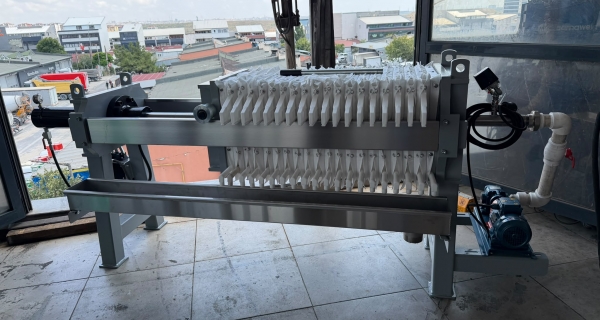
Filter press capacity is not determined simply by asking how many litres of liquid must be treated each day. The key question is how much solid material that liquid carries, how readily the slurry releases liquid, how much cake is produced in each cycle and how many complete cycles can realistically be finished during the available working time.
In practical terms, sizing a filter press is mainly a solids-handling decision. The liquid passes through the cloth, while the retained solids occupy the chambers between the plates. A suitable press must therefore have enough chamber volume and enough daily operating time to collect the expected solids without creating a production bottleneck.
What Does Filter Press Capacity Describe?
Filter press capacity describes the amount of slurry or solids a machine can process within a defined operating period. It depends on the cake volume held in the plate chambers and the time required to complete one full filtration cycle.
Two plants with the same daily liquid volume may need very different presses. A dilute liquid may carry only a small amount of solids, while a thick sludge can fill the chambers quickly. The liquid volume alone therefore does not show how large the press should be.
Start with the Daily Feed Volume
The first step is to identify how much slurry, sludge or process liquid must be filtered during a normal production day. Peak days should also be considered, because a press selected only for average conditions may fall behind when production increases.
It is also useful to understand how the feed reaches the filter press. A steady flow throughout the day creates a different operating requirement from a large batch that arrives at the end of a shift. The same total volume may require a different cycle plan depending on when the material is available.
Solids Content Is More Important Than Liquid Volume Alone
The chambers of a filter press are filled by retained solids, not by the filtrate that leaves the machine. For this reason, the solids concentration of the feed is one of the most important sizing inputs.
A higher-solids slurry generally fills the chambers more quickly and requires more frequent cake discharge. A low-solids liquid may allow a large amount of liquid to pass through before enough cake has formed to fill the press. This is why a tank capacity or daily flow figure cannot be used on its own to select the machine.
Check How the Material Filters
Different materials behave very differently under pressure filtration. Coarse particles that release water easily may form a permeable cake quickly. Fine, sticky or gel-like solids may slow the passage of liquid through the cloth and extend the filling stage.
A sample test provides the clearest picture of this behaviour. It shows how quickly filtrate is released, how the cake builds, how much moisture remains in the cake and whether the cake separates easily from the cloth. These observations allow the press capacity to be based on the actual product rather than a general assumption.
Use the Full Filtration Cycle, Not Only Pumping Time
A filter press cycle includes more than feeding slurry into the machine. Closing the plate pack, filling the chambers, completing filtration, opening the press, discharging the cake and cleaning the cloths when required all consume operating time.
Capacity should therefore be based on the number of complete cycles that can be achieved under real plant conditions. Difficult cake release, manual plate handling, cloth cleaning or waiting for the next batch can reduce the daily number of cycles even when the filtration stage itself is relatively short.
Match Plate Size and Plate Quantity to Cake Production
The spaces between the filter plates provide the volume in which the solids accumulate. Larger plates and a greater number of chambers increase the amount of cake that can be held in one cycle. The correct arrangement is the one that can accept the expected solids load while still completing the required number of cycles within the working day.
An undersized press must be opened and emptied too frequently, which can limit production. An oversized press may take too long to fill and can add unnecessary equipment cost and footprint. Proper sizing balances chamber volume, filtration behaviour and practical cycle frequency.
Consider Available Working Hours and Operating Allowance
The hours available for filtration have a direct effect on required capacity. A press used during one shift must handle more material per cycle than a system that can operate across several shifts. Planned cleaning, maintenance, operator breaks and normal delays should not be treated as productive filtration time.
It is also sensible to leave a reasonable operating allowance. Feed conditions can change, solids concentration may rise and some batches may filter more slowly than others. The allowance should reflect real process variation rather than an arbitrary oversizing decision.
Information Needed for a Reliable Capacity Assessment
A practical filter press capacity assessment should use the following information together:
- Total daily volume of slurry or process liquid
- Approximate solids concentration in the feed
- Particle characteristics, viscosity and general flow behaviour
- Filtration and cake-building behaviour observed during sample testing
- Required cake condition and expected filtrate clarity
- Total time needed for filling, filtration, cake discharge and cleaning
- Daily operating hours available for the press
- Expected changes in production rate or feed composition
When solids content or test data is missing, any stated capacity should be treated only as a preliminary estimate. A reliable selection requires both production information and evidence of how the actual material behaves during filtration.
Conclusion
Filter press capacity is determined by combining daily feed volume with solids loading, filtration behaviour, cake production, complete cycle time and available operating hours. Sample testing then confirms whether the proposed chamber volume can meet the plant's real production requirement.
For an overview of systems that can be configured around different process and capacity requirements, visit the Akfen Engineering filter press page.