 English
 Türkçe
  العربية
  Русский
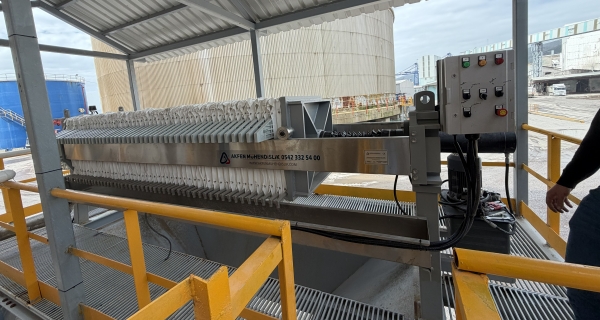
Factors Affecting Filter Press Machine Prices
Filter press machine prices vary depending on the machine dimensions and the level of automation. Since every facility has different daily production capacities, slurry characteristics, and operating conditions, it is not possible to provide a single price that applies to every project.
Accurate pricing begins with determining the specific requirements of the facility. Once the process requirements are identified, the appropriate filter plate size, number of plates, and automation system can be selected. In this article, we briefly explain the main factors that influence filter press machine prices.
Filter Plate Size
One of the primary factors affecting the price of a filter press machine is the size of the filter plates. As the plate dimensions increase, the machine frame, hydraulic system, and overall structure also become larger.
Machines equipped with small plates such as 250×250 mm are generally used for lower-capacity applications, while systems with 800×800 mm or 1000×1000 mm filter plates are preferred for facilities requiring higher filtration capacities.
Choosing the largest available plate size is not always the best solution. Selecting a machine that exceeds the actual production requirements may unnecessarily increase the initial investment cost.
Number of Filter Plates
Two filter press machines with identical plate dimensions may have different prices depending on the number of filter plates installed. Increasing the number of plates expands the filtration volume and allows more filter cake to be produced during each filtration cycle.
The required number of plates should be determined according to the daily processing capacity, target filtration cycle, and desired filter cake volume. Too few plates may reduce production efficiency, while an excessive number of plates can increase investment costs without providing additional operational benefits.
Automation System
Filter press machines can be manufactured as manual, semi-automatic, or fully automatic systems. The selected level of automation has a direct impact on the overall machine price.
Manual Filter Press
Manual systems offer a simple operating structure and are generally the most economical option. They are suitable for lower-capacity operations where plate opening and cake discharge can be performed manually by the operator.
Semi-Automatic Filter Press
Systems equipped with a control panel or joystick allow easier control of the hydraulic piston movement. Some operations, including plate opening and filter cake discharge, are still carried out by the operator.
Fully Automatic Filter Press
Fully automatic systems use automated mechanisms for plate opening and filter cake discharge. These systems reduce labor requirements and shorten operating cycles. Due to the additional mechanical and electrical components involved, they are generally more expensive than manual systems.
Characteristics of the Material Being Filtered
Filter press machines are not limited to wastewater sludge applications. They are also widely used in the filtration of marble slurry, mining products, chemicals, paints, vegetable oils, fruit juice, wine, grape must, and many other industrial products.
Every material has different characteristics, including solid content, particle size distribution, density, and filtration behavior. Therefore, the appropriate filter plate and filter cloth must be selected according to the specific application. Materials requiring specialized filtration solutions may require custom equipment, which can influence the final machine cost.
Filter Cloth and Plate Type
Filter cloths allow liquid to pass through while retaining solid particles on the surface of the filter plates. Using an unsuitable filter cloth may reduce filtration efficiency and negatively affect filtrate quality.
The type of filter plate should also be selected according to both the process requirements and the material being filtered. The dimensions, quantity, and specifications of chamber plates or recessed chamber plate configurations are among the factors considered during pricing.
Machine Capacity
The capacity of a filter press cannot be evaluated solely by its external dimensions. Plate size, number of plates, and the filter cake volume produced by each plate must all be considered together.
Selecting a machine without accurately calculating the required daily capacity may result in insufficient filtration cycles or the purchase of an oversized system. For this reason, determining the actual production capacity is essential before preparing a price quotation.
Optional Equipment and Custom Engineering
Additional features such as chain-driven plate shifting systems, plate shaking mechanisms, automatic plate transport devices, and advanced control equipment can affect the overall machine price.
Custom modifications may also be required depending on the installation site, including changes to the machine frame dimensions, construction materials, or connection points. Project-specific engineering solutions generally require customized pricing compared to standard machine designs.
How Is the Most Suitable Filter Press Price Determined?
The most suitable filter press is not necessarily the machine with the lowest purchase price. The ideal solution is one that meets the required production capacity, is compatible with the material being filtered, and provides reliable long-term performance.
At Akfen Engineering, we evaluate the characteristics of the material to be filtered, the required daily processing capacity, and the desired automation level to determine the most suitable filter press solution for each customer. When necessary, filtration tests are carried out using customer samples to select the appropriate filter plates and filter cloth.
To learn more about our filter press models, technical specifications, and manufacturing options, please visit our Filter Press product page.
Conclusion
Filter press machine prices depend on several factors, including filter plate size, number of plates, automation level, processing capacity, characteristics of the material being filtered, and optional equipment. Therefore, comparing machines based solely on their dimensions may not provide an accurate evaluation.
If you would like assistance in selecting the most suitable filter press machine for your application, receive technical information, or request a project-specific quotation, feel free to contact the Akfen Engineering team.
Read More