 English
 Türkçe
  العربية
  Русский


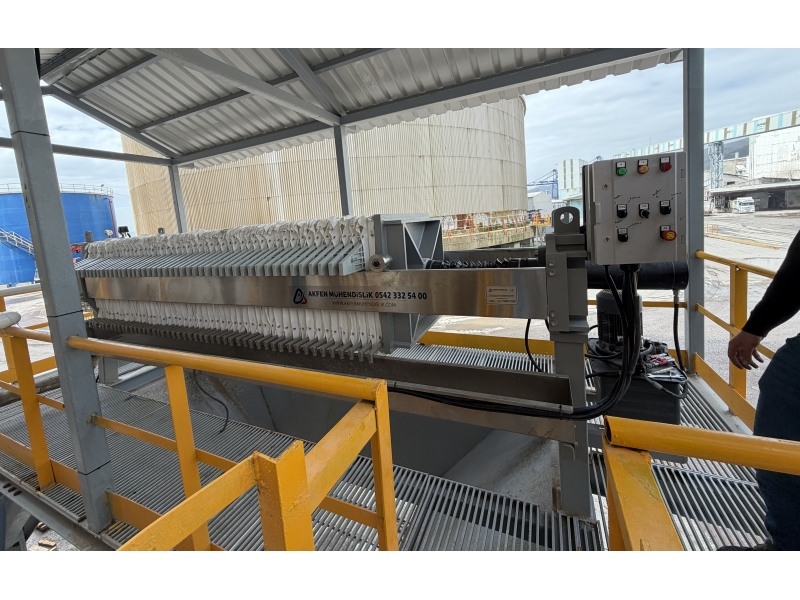
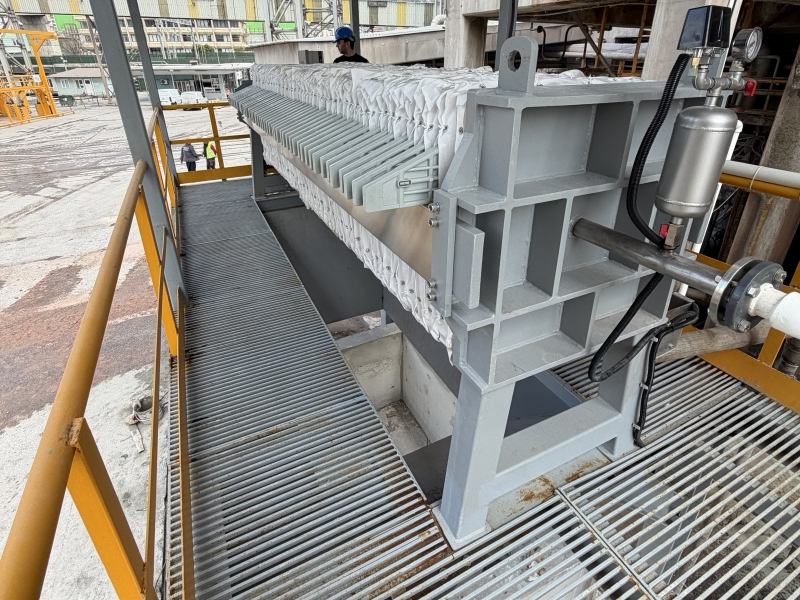
Filter Press
Filter press separates the solids contained in liquids (sediment, pulp, etc.) with the help of filter plates and filter cloths, turning the solid product into filter cake. A filter press machine is an industrial filtration system used to separate solids from liquids.
The plate size, number of plates and filter cloth are selected after evaluating the structure of the product to be filtered, its solids content, daily production volume, the required filtration result and operating conditions. Akfen Mühendislik is a filter press manufacturer offering project-specific solutions in plate sizes from 250x250 to 1000x1000.
How Does a Filter Press Work?
The filter press plates are clamped together by a hydraulic piston. The product to be filtered is then pumped into the machine. The liquid passes through the filter cloths and is discharged from the machine, while the solids are retained between the plates and gradually build up to form filter cake. Once the chamber between the plates is completely full, filtration is stopped and the hydraulic piston retracts. The plates are separated and the accumulated filter cake is discharged. After cleaning, the plates are clamped together again and the machine is ready to filter.
Filter Press Manufacturing Options
Every facility has different filtration needs. Filter presses are manufactured with different plate sizes, plate counts and operating systems according to the facility's capacity, the characteristics of the product to be filtered and the working conditions.
| Feature | Description |
| Machine Frame | ST37 carbon steel, epoxy primer and corrosion-resistant paint |
| Head and End Plates | Prevent the product from coming into contact with the machine frame |
| Filter Plates | PP (Polypropylene) |
| Plate Types | Chamber and solid-hollow (plate and frame) |
| Plate Sizes | 250x250, 400x400, 500x500, 630x630, 800x800, 1000x1000 |
| Number of Plates | Determined according to daily production capacity and plate size |
| Discharge System | With taps (open system) or closed (piped) system |
Filter Press Models by Automation Level
Filter presses can be manufactured with different levels of automation according to the facility's capacity, daily workload and operator requirements.
Hand-Jack Operated Filter Press
A manual system in which the hydraulic piston is moved with a hand jack. It is generally used in filter press machines up to 500x500 mm.
Hydraulic Controlled (Joystick) Filter Press
The piston is moved forward and backward with a joystick on the hydraulic unit. After filtration is complete, the plates are opened manually by the operator.
Control Panel Filter Press
With a single button on the control panel, the piston closes automatically until it reaches the set pressure and stops automatically when the process is complete. When the piston retracts and reaches the switch, the system stops itself.
Chain-Type Filter Press with Cake Shaking
When the piston retracts, all filter plates are opened at the same time by the chain system. The shaking system then releases the filter cake from the plates.
Fully Automatic Filter Press with Plate Carriage and Shaking
The plates are picked up one by one by a moving carriage, pulled out, shaken and put back. After filtration, the system continues the operations automatically.
Filter Press Applications
Filter press machines can be used in many industrial processes to separate solids from liquids.
- Wastewater treatment
- Sludge dewatering
- Marble and natural stone processing
- Mining and ore processing
- Chemical industry
- Paint and coating
- Ceramic and clay processing
- Metalworking and surface treatment
- Paper and recycling
- Vegetable oil filtration
- Food and beverage production
- Liquid fertilizer production and filtration
- Other industrial processes requiring solid-liquid separation
Filter Press Prices
Filter press prices vary according to plate size, number of plates, machine length, automation level, plate handling system and the additional equipment used in the project. For this reason, it is not accurate to set a single standard price for filter presses of different capacities and specifications. The capacity and machine specifications required by the facility should be determined first, and pricing should then be prepared to suit the project.
What Information Do We Need for a Price Quotation?
The type of product to be filtered, its solids content, the daily quantity to be processed, the desired automation level and the preferred discharge system. Using this information, we determine the suitable plate size and number of plates and prepare a project-specific price quotation.
Product Testing and Sample Analysis
Every product behaves differently during filtration. Even two products with the same solids content may have different filtration times and different filter cake structures due to their particle structure and physical properties. For this reason, when needed, a filtration test can be carried out on a sample taken from the product to be filtered. Based on the results, the appropriate machine specifications can be determined more reliably.
Contact us to determine the filter press machine that suits your facility, for product testing, or for a project-specific price quotation.
Filter Press Plate Sizes and Cake Volume Table
When selecting a filter press machine, plate size and number of plates are among the most important criteria directly affecting filtration capacity and the volume of filter cake obtained. The table below shows approximate cake volumes for standard filter press plate sizes. You can get support from our expert team to determine the filter press model best suited to your facility.
| PLATE SIZES (mm) | 250X250 | 400X400 | 500X500 | 630X630 | 800X800 | 1000X1000 | |
|---|---|---|---|---|---|---|---|
| CAKE VOLUME | 1,0 | 2.5 | 5.50 | 8.50 | 16.0 | 24.0 | |
| NUMBER OF PLATES | 5 | 5.0 | 12.5 | 27.5 | 42.5 | 80.0 | 120.0 |
| 10 | 10.0 | 25.0 | 55.0 | 85.0 | 160.0 | 240.0 | |
| 15 | 15.0 | 37.5 | 82.5 | 127.5 | 240.0 | 360.0 | |
| 20 | 20.0 | 50.0 | 110.0 | 170.0 | 320.0 | 480.0 | |
| 25 | 25.0 | 62.5 | 137.5 | 212.5 | 400.0 | 600.0 | |
| 30 | 30.0 | 75.0 | 165.0 | 255.0 | 480.0 | 720.0 | |
| 35 | 35.0 | 87.5 | 192.5 | 297.5 | 560.0 | 840.0 | |
| 40 | 40.0 | 100.0 | 220.0 | 340.0 | 640.0 | 960.0 | |
| 45 | 247.5 | 382.5 | 720.0 | 1080.0 | |||
| 50 | 275.0 | 425.0 | 800.0 | 1200.0 | |||
| 55 | 302.5 | 467.5 | 880.0 | 1320.0 | |||
| 60 | 510.0 | 960.0 | 1440.0 | ||||
| 70 | 1120.0 | 1680.0 | |||||
| 80 | 1280.0 | 1920.0 | |||||
| 90 | 1440.0 | 2160.0 | |||||
| 100 | 1600.0 | 2400.0 | |||||
Filter press prices are determined according to the plate size, number of plates, automation level and technical specifications. After evaluating your requirements, we prepare a customized quotation for your project.
It is determined by taking into account the sludge volume (flow rate), solid content, target cake density, daily operating hours, and cycle count. You can contact our technical team to determine the most suitable capacity and plate sizes for your project.
Akfen Engineering offers filter press solutions with plate sizes of 250×250, 400×400, 500×500, 630×630, 800×800 and 1000×1000 mm. The appropriate size and number of filter press plates are determined based on the characteristics of the material to be filtered and the facility’s capacity requirements.
For more information about different filter press cloth options and their specifications, visit our filter press cloth page.
Yes. The sample you send to us is analyzed under laboratory conditions to determine the most suitable filter plate type and filter cloth for your application.
Filter press machines are widely used in wastewater treatment, marble processing, mining, chemical, paint, ceramic, paper, vegetable oil and food industries, as well as many other industrial applications requiring solid-liquid separation.
Yes. We manufacture custom filter press solutions based on your production capacity, product characteristics and process requirements.
Akfen Engineering filter press machines are covered by a 24-month warranty. For detailed information about warranty terms and our after-sales support services, please feel free to contact us.
The delivery time for filter press machines is between 2 and 6 weeks. It varies depending on the selected model, capacity, and production schedule. You can contact us to get information about the current delivery time.
Yes. We provide technical support during the installation of our filter press machines. We supply all necessary installation information and provide additional technical assistance whenever required.
Yes. We provide spare parts supply and technical support for all our filter press machines. Remote technical assistance is available whenever possible, and on-site support can also be provided when required.